Philosophy. Mentality. Ideas on Life. All about unlocking your inner potential. From the desk of an athlete, builder, and philosopher. Every Monday. 7 AM EST.
The Key to Progress | Play the Infinite Game
Yo! This is edition #2 of DISRUPT.
It’s currently 4:47 PM.
It’s very very rainy.
The perfect time to write.
I hope you takeaway something valuable from this post. Enjoy.
In the past 6 months, I’ve been intentionally diving deeper and deeper into my interests and curiosities.
As I’ve been doing so, I’ve had the opportunity to build some pretty cool projects.
- Revolutionizing Lung Cancer Diagnosis via CRISPR-CAS12a
- Recommending Amazon Alexa their next big product | AlexaHub
- Recommending Walmart a way to enhance customer experience | Cart Displays
I’ve been attempting to improve my times on the track and have achieved some success.
- Brought down my mile time by a minute.
- Brought down my 2 mile time by 2 minutes.
Yet, after finishing each project I always felt left hanging.
After each race on the track, I’d sometimes feel the same as well especially after reaching a new personal best.
“Well what now?”
Recently, I revisited this older twitter post.
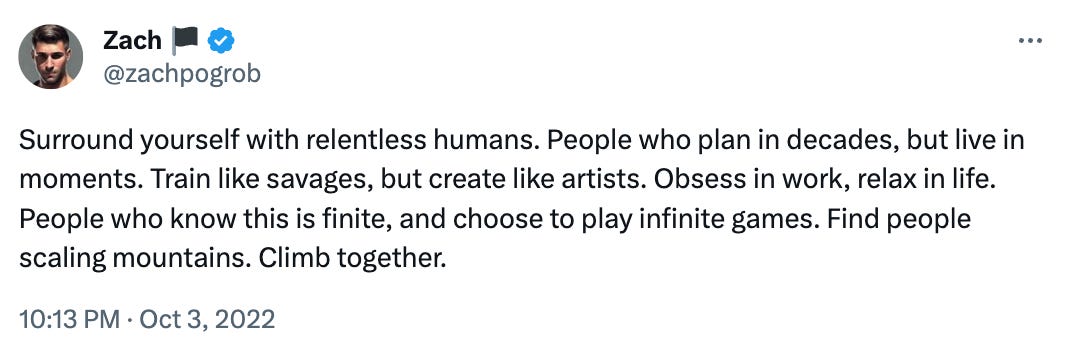 |
There was a single line that stood out to me. One that I had never fully grasped before.
Naturally I dove deeper and I found something very valuable.
Infinite Games vs Finite Games
There are two types of games in life.
- Finite Games
- Infinite Games
Finite games are bound to a set of rules.
There are only known players.
There’s a pre-existing agreed upon objective.
There is a winner and loser.
The game has a beginning, middle, and an end.
Infinite games aren’t bound to a set of rules. The rules can change.
There are known and unknown players.
The objective of this game is to keep the game going as long as possible.
An example of a finite game is a game of basketball.
There are 2 teams with 5 players each.
The game ends after 48 minutes.
The objective of this game is to win. Whoever scores the most points wins.
This implies that there is a loser.
An example of an infinite game is the career of a basketball player
There are known players (teammates, rivals, coaches) and unknown players (emerging talents and younger players).
There is no winner or loser.
There are no exact or agreed upon rules.
The objective of this game is to keep playing basketball at a top level and continue improving for as long as possible.
Being consistent in winning basketball games (finite game) will be conducive towards a basketball player’s career (infinite game). The more they win, the more they can keep playing basketball at the top level and keep improving.
Within an infinite game, playing finite games are needed to conduce the infinite game.
For example, lets say I want to play the infinite game of improving the world as much as I can through entrepreneurship.
I would need to play the finite games of building a product that is beneficial to the consumers, launching that product, pitching to investors, and hitting revenue targets. Being successful in those finite games would be conducive towards the infinite game of improving the world.
Without playing those finite games, keeping the infinite game going would not be possible.
The Modern Dilemma
The modern world is filled with attractive finite games.
Lots of people prioritize these finite games over infinite games.
- Playing a game to get rich only for the purpose of getting rich
- Playing the game of school only to get a diploma
- Playing games only to win over competition
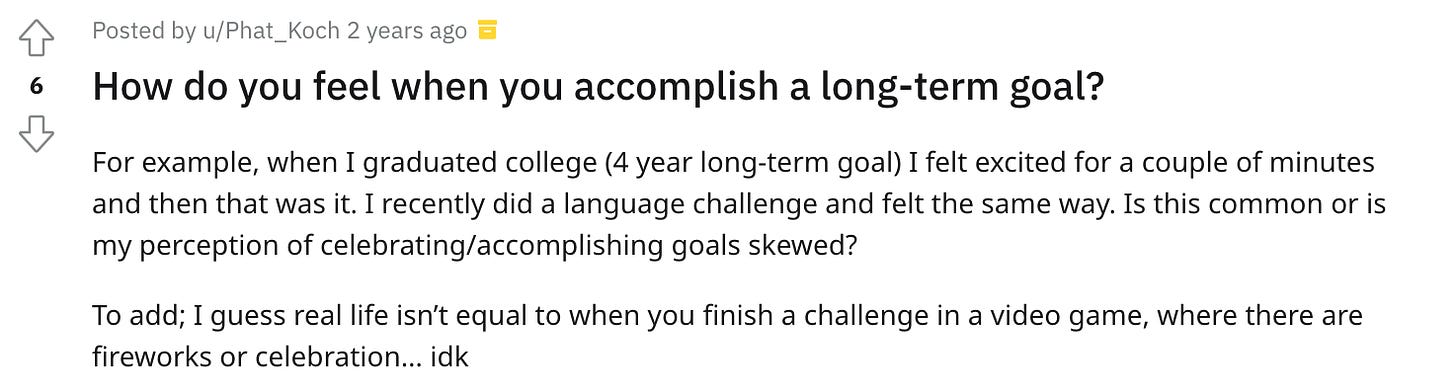
Once people finish their finite game, what’s next?
After people are done with their finite game many feel lost.
A whole lot of energy and focus is purely put into winning that finite game that they expect something huge out of winning the finite game.
But in reality, once you’re rich, the only thing that has changed is your wealth.
Once you’ve gotten your diploma, the only thing that has changed is that you don’t have to go to school.
Once you’ve won in a competition, the only thing that you’ve gotten is a temporary victory.
Without having an infinite game to play, these results will eventually mean nothing to a finite player.
Victory might feel satisfying at first, but that feeling eventually subsides.
 |
What would a finite player do after winning a finite game?
They might sign themselves up for another one.
Just to keep winning and prove to others that they’re capable of winning again.
Only for the purpose of experiencing a victory.
But if they lose, that becomes a problem for them.
Finite players have an irrational need to showcase their wealth and status.
They tend to sulk in the past because that is where their victories lie.
Finite players might begin to develop a sense of stubbornness on winning a finite game for momentary triumph diving into the sunk cost fallacy.
Finite players are purely results based.
Finite players feel too proud of their victories developing an overwhelming ego.
Finite players sulk in their losses and may be unable to rise from them.
Playing finite games aren’t inherently bad.
- They can put you in a better situation when you succeed.
- They can give you something to learn from when you lose.
But playing a finite game without the mindset of an infinite player is redundant.
Be an Infinite Player
Prioritize the infinite game over finite games.
Don’t get stuck in a finite mindset. Get stuck in an infinite mindset.
And live an infinite life of fulfillment.
You choose your infinite game.
- Your infinite game should be based on the intersections of your personal values and your personal interests.
- Your infinite game should be towards growth and improvement.
For example, I value self-improvement, and I’m interested in running. My infinite game would be improving myself through the sport of running. The objective would be to continue to improve and get faster as much as I can because I truly value it.
To keep my infinite game going, it’s inevitable that I would have to play a series of finite games.
If I want to keep improving, I have to keep training and competing.
I have to set goals within each training cycle and each race.
I may aim to beat other runners of a similar caliber.
But not for the purpose of beating them.
For the purpose of keeping my infinite game of self-improvement going.
With this perspective, other runners in a race aren’t my competition, instead they are my teammates guiding me to continuous improvement.
THE KEY THING - When you play these finite games, you must keep your infinite game in mind. You must embody the mindset of an infinite player.
Within each finite game, you might win or lose.
When you keep the infinite game in mind, whether you win or you lose at a finite game, you gain something out of either outcome.
Winning would let you keep the infinite game going.
Losing would allow you to learn something valuable out of the experience which would keep the infinite game going. It doesn’t end when you lose.
- “How can I improve?”
- “How can I keep going?”
When you’re an infinite player and you focus on improving, losing doesn’t exist.
You become process based rather outcome based.
This will lead you to growth.
Growth doesn’t occur by purely focusing on the outcomes (like a finite player).
It occurs by focusing on the long-term process of growth.
Yes, you will experience a sense of accomplishment as you find positive outcomes within finite games. But those positive outcomes have a bigger meaning. They are no longer just momentary outcomes, they are kindling to keep your infinite game going.
The purpose of playing the infinite game is exemplify and bring what we personally value into play. It is never ending and there is potential to live a life of fulfillment if that infinite game exemplifies something you value.
It’s prerequisite to living a life of fulfillment.
It fits together like a puzzle. You just have to find the matching pieces.
You can learn on how to begin to find these puzzle pieces in DISRUPT’s first edition.
My Use Case Scenario
I mentioned earlier that after creating those cool projects and achieving some success in the sport of running, I’d sometimes feel that I was left hanging.
Looking back, I realize it was due to a lack of big picture thinking.
I wasn’t 100% sure how building those projects would ultimately fit in my future.
I wasn’t entirely satisfied in the results I got in those races.
I realized that sometimes I would expect huge outcomes from temporary results.
I was focusing too much on the immediate outcomes rather than the long term gains.
I now realize a better way for me to mentally frame success in racing and those projects is to see them as external vessels that keep my personal infinite game going. Without them, I wouldn’t be able to continue playing the infinite game of improvement.
See y’all next week ✌️
Twitter - vxnuaj_
If you enjoyed this edition of DISRUPT, share it with a friend!
If you aren't subscribed to DISRUPT yet, click here to join.
You won't regret it ;)
See you next week Reader.

DISRUPT
Philosophy. Mentality. Ideas on Life. All about unlocking your inner potential. From the desk of an athlete, builder, and philosopher. Every Monday. 7 AM EST.
This is DISRUPT #8 - Passion is built. Not Found Let me start by saying this: Passion is cliché. The modern concept of passion is heavily misunderstood. It’s also heavily overused. Combine the overuse and misunderstanding of the passion and it provides a false idea of what a meaningful life is for those who want to live a meaningful life filled with joyful fulfillment. It provides a false idea of achieving what one considers to be success. “Find your passion” is common advice but it is not...
Yo! This is DISRUPT Edition #7. It’s been about 2-3 weeks since DISRUPT’s previous newsletter, so I hope you’re itching for some valuable content. I’ve been diving into Friedrich Nietzsche’s philosophical ideas over the past couple weeks. I find him and his ideas very interesting and quite useful in my life. In fact, I found that he and I shared very similar ideas and viewpoints on life and the world around us. As I dived into Nietzsche’s philosophy, I found that it provides a good viewpoint...
Yo! This is DISRUPT #6. For those who have subscribed, thank you for the support. I hope you continue to learn and apply what you learn, to your own life. For those who have been sent this, welcome. This is a newsletter for those who want to continue learning and growing as a person. Just like me. If you found this newsletter interesting, consider joining the mailing list. In this edition of DISRUPT, you will see some scientific terms describing some proccesses of our brains. It brings to...